Where It All Began

A SMALL MARKET.
A FAMILY KITCHEN.
A CHICAGO STORY.

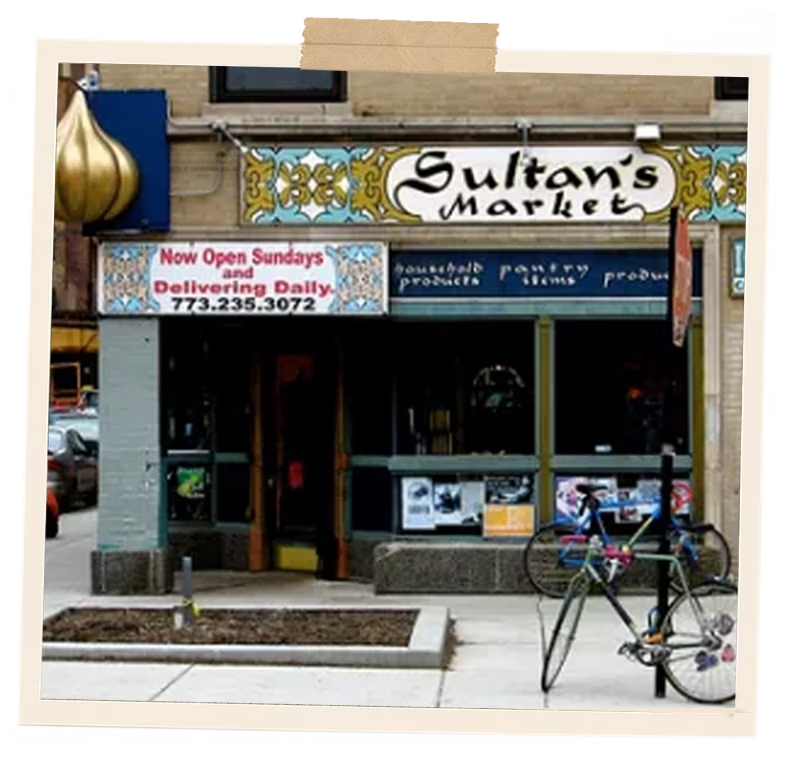
Long before Sultan’s Market became known for its falafel, it was a neighborhood market on North Avenue with a small kitchen in the back.

When founder May Ramli came to Chicago from Jordan, she started by serving the kind of food she thought the neighborhood already knew. Then one day, she brought in fresh hummus she had made at home.

People loved it.

That homemade hummus opened the door to something bigger. Little by little, the familiar American sandwiches gave way to the Middle Eastern food May knew and loved falafel, lentils, spinach pies, baba ghanouj and more.

What started as one small neighborhood shop was beginning to find its identity.

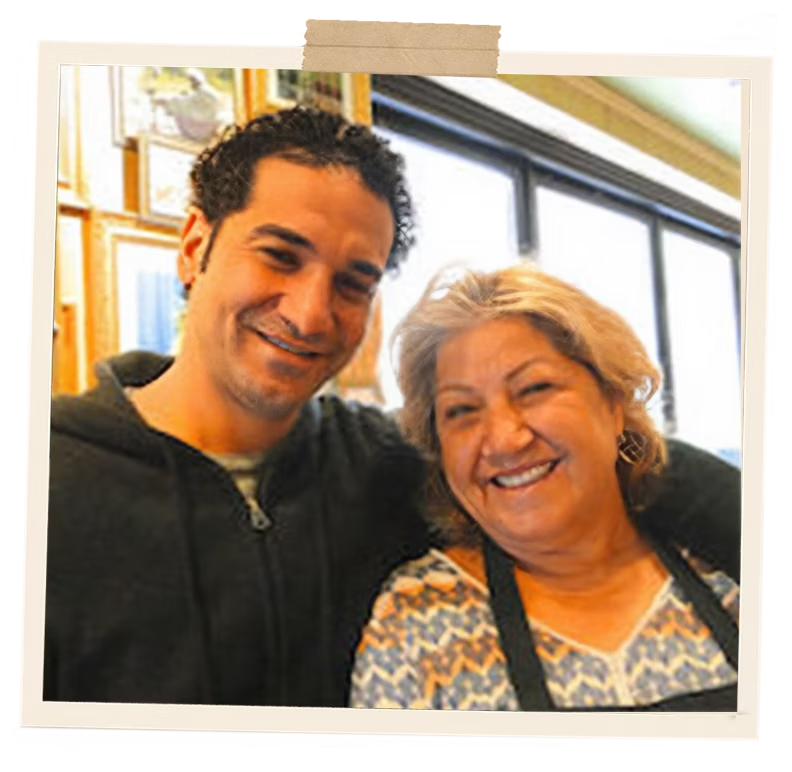
Sultan's Market Story - May Ramli & Shadi Ramli

About Sultan's Market

ROOTED IN TRADITION.
GROWN IN CHICAGO.

That little shop on North Avenue became something May probably couldn't have imagined at the beginning.

Neighbors came back. They brought friends. Families made Sultan’s part of their routines. And over the years, what began in Wicker Park grew into four Chicago neighborhoods; each with its own personality, but all sharing the same food and welcoming spirit.

Through all that growth, the heart of Sultan’s hasn’t changed. Our kitchens are still built around food prepared fresh every day: falafel frying, shawarma roasting, lentil soup simmering, vegetables being chopped, and hummus being made for another day of hungry Chicagoans.

Today, Sultan’s Market is more than the little neighborhood market where the story began. It’s a Chicago staple shaped by the people who have walked through our doors for more than 30 years.

And we’re still cooking for Chicago the same way we always have, fresh, generous, and made to be shared.

Savor the Tradition Today

Ready to Taste 30 Years of Tradition?

Stop by your nearest neighborhood spot or view our full scratch-made menu.

1

How a neighborhood kitchen became a Chicago staple

Sultan's Market didn’t start as a brand, it started as a kitchen. A place where family recipes, careful preparation, and the aromas of Middle Eastern spices came together to serve the surrounding community.

Over the years, as Chicago neighborhoods evolved, Sultan's grew alongside them. From Wicker Park to Logan Square, Lincoln Park to Pilsen, each location reflects the energy and character of its neighborhood, while staying true to the flavors and care that built Sultan's reputation.

2

Tradition meets modern urban food culture

Food traditions carry stories. They connect generations, cultures, and neighborhoods. At Sultan's Market, we honor those traditions while embracing the rhythm of the city around us.

Our kitchens are places of motion and life, Falafel frying, Shawarma roasting, sauces being prepared fresh. The food is rooted in heritage, but the experience feels urban, vibrant, and alive. This is not fast food. This is made-to-order Middle Eastern cooking shaped by Chicago.

3

Family roots, real kitchens, real people

Behind Sultan's Market is a family story. One built on long days in the kitchen, learning from elders, perfecting flavors, and serving guests with pride.

Many of our team members have grown with Sultan's over the years. They are the hands behind the food and the faces behind the counter. Sultan's is not a concept. It’s a group of people who care deeply about what they serve and the communities they serve it to.

4

Your daily craving, made to order

Everything we serve is prepared in our kitchen every day. From our Falafel and Shawarma to our Soups, Salads, and Sides, freshness is not a trend, it’s our foundation.

We believe Middle Eastern Food should feel vibrant and generous. Bold spices, fresh herbs, warm breads, slow-roasted meats, and plant-forward dishes all come together to create food that is comforting, nourishing, and full of character.

Whether you eat meat, eat plant-based, or mix both, Sultan's Market has always been a place where everyone can find something to love.

5

Part of Chicago’s food culture

Sultan's Market belongs to Chicago. For decades, we’ve served students, families, artists, late-night crowds, longtime locals, and first-time visitors discovering us for the first time.

Our locations live inside real neighborhoods. They reflect the diversity, creativity, and warmth that make this city what it is. Sultan's is not just a restaurant people visi, it’s a place many Chicagoans grow up with.

Follow Us

Our Story

From the Chicago Tribune: JUNE 11, 2003​

The Chicago Tribune once described Sultan's Market as “a savory oasis.” Here is an excerpt from their feature on our story and roots in Chicago. 

From the Middle East comes a Savory Oasis

By Annemarie Mannion Special to the Tribune

A gold, onion-shape dome decorating the entrance to this storefront is one sign that Sultan's Market is not your average convenience store. So is the long line of people that weaves between shelves packed with grocery store offerings. But the food they’re waiting for is what really sets this store apart: mild or spicy falafel sandwiches, bowls of rice and lentils, spinach pie by the slice.

This Middle Eastern food is a far cry from the meatball sandwiches, hot dogs and Polish sausage that were first offered when the owner, May Ramli, opened the store at 2057 W. North Ave. 12 years ago. Ramli, who emigrated from Jordan in 1984, acknowledged that her first instinct was to offer food that she thought customers would recognize and like. But one day she brought in some fresh hummus she had made at home in her blender. To her surprise, it was a hit. “I didn’t know they would know hummus, but it sold out,” she said. “They knew hummus from a can. They said they never ate hummus like mine.” That was the beginning of the end in the store for typical American sandwiches. “No hot dogs. No Polish sausage. No Italian beef. No grease,” said Ramli, who continues to oversee preparation of the foods and work the cash register.

Departing from the past Although running a restaurant is now part of Ramli’s business, visiting one was not a common experience when she was growing up in Jordan. “I didn’t go to a restaurant until I was 18 years old. I couldn’t afford it,” she said. She said she learned in her mother’s kitchen how to make the dishes that now are staples to her customers. The popularity of her Middle Eastern food, much of it vegetarian, has enabled Ramli to expand the store that she operates with her son, Shadi, 25. Ramli also has a daughter, Nesreen, a college student who helps in the store during the summer. 

Sultan’s Market’s fresh food has become “the backbone of the business.If it weren’t, we wouldn’t be here because the rent is so high,” said Shadi Ramli, who oversaw the construction of a larger kitchen three years ago. His influence is seen in many other areas, including the decor (booths topped with Middle Eastern-style arches) and the music, which ranges from modern American to old rock to classic Arabic.

Shadi Ramli, who was 6 when he moved to the U.S., said he grew up helping with the business and seeing his mother prepare food for the store. “She used to do everything in our oven at the house,” he said. “In the morning before school, we’d be folding dough [for spinach pie], then she’d pop it in the oven.” The kitchen, in the back of the store along with a steam table, is where customers gravitate to order hummus by the pound, lentil or chicken potato soups, tabbouleh, baba ghanouj, and lamb kebab sandwiches. In good weather, there’s seating on the patio.

Watching a work in progress Waiting one afternoon recently as her falafel sandwich was prepared, customer Heather Graff said she has enjoyed watching the metamorphosis of the business since the store opened. “I’ve seen it change from a corner store to a restaurant. The food is really good, spicy and fresh, and it’s atmospheric,” said Graff, who lives three blocks away. “This is the best place in the neighborhood,” said customer Tony Escobedo, who lives in the Ukrainian Village neighborhood. “You should see the line out the door at dinner. Everybody’s in here for good, cheap eats.” Indeed, maintaining reasonable prices is a priority for Ramli. “I don’t do it only for the money,” she said. “I like people. I like to cook. If I wanted to work for money, I’d be a millionaire.

”Besides the prepared items, the store has a colorful salad bar, on which standard items are accompanied by more unusual selections: roasted brussel sprouts, golden raisins, fried plantains and vegan salad dressings. Sultan’s Market also sells typical convenience-store items, from Twix bars to toilet paper, but it stocks ingredients for many ethnic dishes as well: packaged pita bread, tahini, olive oil, miso soup mix. Thinking globally The market is planning to offer an even wider range of ethnic foods in the future. “Right now I’m trying to hunt down a honeydew[-flavored] ice cream that a Korean friend gave to me at his house,” said Shadi Ramli.

Expanding the line of ethnic foods, even going beyond those traditionally associated with the Middle East, is in keeping with the store’s focus, he said. “I see it as going back home,” he said. “The Middle East was a trade hub, so you had all these different kinds of foods and flavors passing through there.” He said the exciting part of running Sultan’s Market is exploring its potential. “This place is always changing,” he said. “We’re always adding to it.” He has plans in the next few months to open a juice/coffee bar and would like to add T-shirts, incense, body oils and occasionally live music. Although it may seem a grand vision for a convenience store, he said, food and music from a variety of cultures are ways to build bridges. “It’s nice to show a little bit of each culture,” he said. “That way we aren’t so afraid of each other.”

Have questions before your visit?

View Sultan’s Market FAQs →